
Engine Coolant Over Temperature: What It Means and How to Fix It Fast
Your dashboard lights up, the temperature gauge shoots into the red, and suddenly you’re wondering if your car is about to become a very expensive paperweight. Sound familiar? If you’ve ever seen the engine coolant temperature warning light flicker on, you know how unsettling that moment can be.
Here’s the good news: understanding what’s happening under the hood can help you act fast and avoid serious damage.
What Does “Coolant Over Temperature” Actually Mean?
Your vehicle’s cooling system works constantly to keep the engine running within a safe operating temperature range. When that system struggles, heat builds up fast. The coolant over-temperature warning light is your car’s way of saying the engine is overheating and needs attention – right now.
This isn’t a warning you can ignore and deal with later. An overheating engine can warp the cylinder head, blow the head gasket, or even crack the engine block. Any one of those repairs will cost significantly more than catching the problem early.
Common Causes of an Overheating Engine
There’s rarely just one reason an engine runs too hot. Here are the most frequent culprits:
- Low coolant level – A low coolant level in the reservoir is one of the most straightforward causes. Coolant can drop due to leakage or gradual evaporation.
- Coolant leak – If you notice a puddle or wet spots under your vehicle, or smell something sweet near the engine compartment, you likely have a leak. Don’t ignore it.
- Faulty thermostat – A thermostat stuck closed prevents coolant flow and causes heat to build rapidly.
- Failing water pump – The water pump is responsible for keeping coolant moving through the system. If it malfunctions, the coolant won’t circulate properly.
- Blocked radiator – A clogged or damaged radiator can’t dissipate heat effectively, especially if air flow is restricted.
- Damaged radiator cap – A worn radiator cap can’t maintain proper pressure, which means coolant boils sooner than it should.
Some vehicles, like the Ford Fusion, are known for specific cooling system sensitivities. If you drive one, it’s worth staying ahead of routine checks.
What to Do When the Temperature Warning Light Comes On
First, don’t panic – but do act quickly. Here’s what to do:
- Pull over safely as soon as possible – it’s not safe to drive with an overheating engine.
- Turn off the air conditioning and roll down the windows to reduce engine load.
- If you must drive briefly in traffic, turn on the heater and set the fan to high to help draw heat away from the engine.
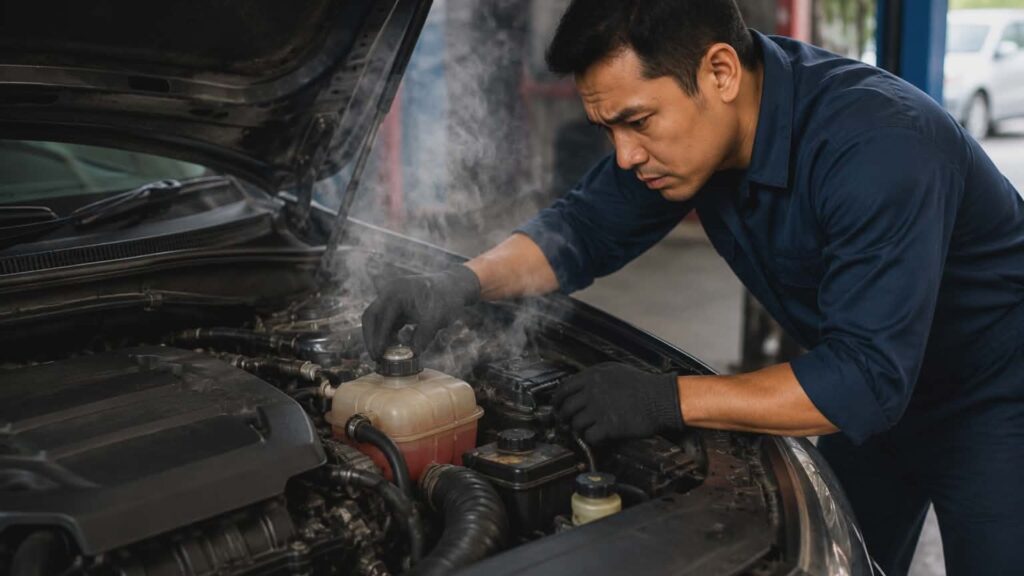
- Once stopped, let the engine cool completely before opening the hood. You could be met with hot steam that looks like smoke if you open it too soon.
- After the engine has cooled, check the coolant level in the reservoir. If it’s low, adding coolant (the correct type of coolant for your vehicle) can help – but only as a temporary fix.
- If you notice a leak or the problem persists, call for roadside assistance. Do not continue driving.
Never remove the radiator cap while the engine is still hot. The pressure inside can cause serious burns.
Why You Shouldn’t Just Top Up the Coolant and Move On
It might be tempting to simply top up the coolant level and call it a day. But if your coolant temperature keeps rising, something is wrong with the cooling system itself. A one-time refill won’t address the issue if there’s an underlying problem with the cooling system, like a failing thermostat, a damaged head gasket, or a weak water pump.
A professional inspection through advanced automotive computer diagnostics can pinpoint the exact cause, saving you from guessing – and from making things worse.
When to Check Coolant Levels Regularly
The best way to avoid an overheating crisis is to check coolant levels as part of your regular maintenance routine. Catching a low coolant level or a slow leak early is far cheaper than replacing a warped cylinder head.
At Don & Joe’s Auto Service in New Castle, IN, the team offers routine preventative maintenance services that include cooling system inspections. Staying on schedule means fewer surprises on the road.
How Don & Joe’s Can Help
Whether you’re dealing with an overheating engine right now or you want to inspect your vehicle before a problem develops, the ASE-certified technicians at Don & Joe’s Auto Service are ready to help. They offer vehicle heating and cooling system repair, professional engine repair services, and comprehensive auto repair services – all backed by a 1-year warranty on most parts and labor.
If your car won’t start after overheating, or you’re seeing engine cooling issues that keep coming back, don’t wait it out.
Conclusion
An engine coolant over-temperature warning isn’t something to shrug off. Acting fast, understanding the common causes, and getting a proper diagnosis can mean the difference between a simple fix and a costly engine repair. If your temperature gauge is climbing or your warning light just came on, call Don & Joe’s Auto Service in New Castle, IN at 765-529-3555 to schedule an inspection today. Your engine will thank you.