

Why Your Car AC Smells Musty
That stale, locker-room smell that hits you when you first crank up the air conditioning is not just unpleasant – it is a warning sign. Your car is telling you that something is growing inside the ventilation system, and it is usually mold or mildew.
Understanding why this happens can help you fix it faster and avoid breathing in contamination every time you drive.
What Is Actually Causing That Musty Smell?
The short answer is moisture. Your vehicle’s air conditioning system pulls warm air across a component called the evaporator, which is a cold, metal coil tucked behind your dashboard. As warm, humid air contacts that cold surface, condensation forms – just like a cold glass of water on a hot day.
Under normal conditions, that moisture drains away through a small drain tube. But when dust, pollen, and debris build up on the evaporator over time, they trap that moisture. Sitting water plus organic debris is exactly the environment that mold and bacteria need to thrive.
Musty odors from automotive air conditioning are one of the most common complaints drivers report, particularly in humid climates where the system runs frequently.
Why the Evaporator Is the Real Problem
The evaporator sits inside your heating, ventilation, and air conditioning (HVAC) housing – completely out of sight. Air is pushed through it by a centrifugal fan (also called the blower motor), which circulates air through the ducts and out your vents.
Because the evaporator stays cold and wet during operation, it is a magnet for biological growth. Mold spores, bacteria, and mildew do not need much – just a little moisture, a little warmth after the system shuts off, and something to feed on. Accumulated dust, pollen, and debris on the evaporator surface give them exactly that.
Plastic housing surrounding the evaporator can also harbor mold in crevices that are nearly impossible to clean without professional equipment.
Signs Your Car AC Has a Mold or Mildew Problem
You do not need a mechanic to recognize the early signs and symptoms. Here is what to watch for:
- A musty or sour odor that appears immediately when you turn on the AC or heat
- A smell that fades after a few minutes but returns the next time you start the car
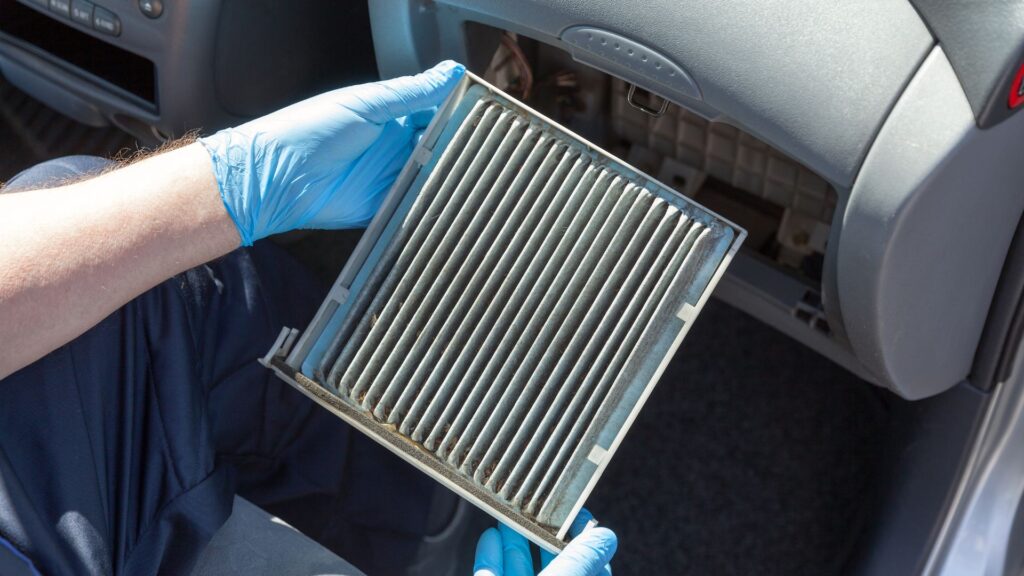
- Reduced airflow from the vents, which may signal a clogged air filter or debris buildup
- Visible dust or dark spots around the vent openings
If your Toyota or any other vehicle is showing these signs, do not assume it will clear up on its own. Mold does not self-correct – it spreads.
How Does Humidity Make It Worse?
Humidity plays a major role. The higher the humidity outside, the more condensation your evaporator produces. During warm, sticky months, your AC works harder, generates more moisture, and gives mold more opportunity to grow.
Bacteria and mold release odorous compounds into the airflow, which is why the smell travels directly into the cabin. You are essentially breathing in whatever is living on that evaporator.
What Can Be Done to Fix It?
The most effective solutions involve cleaning or treating the evaporator and replacing a dirty air filter. Some drivers try spray treatments sold at auto parts stores, but these only address surface-level contamination. For a thorough fix, professional service is the better option.
A trained technician can apply an antimicrobial treatment or use steam cleaning to eliminate mold and bacteria deep within the HVAC housing. Replacing the cabin air filter is also a critical step – a clogged filter restricts airflow and traps more pollen and debris against the evaporator.
Leaving the system on “fresh air” mode for the last few minutes of your drive, rather than recirculated air, also allows the evaporator to dry out slightly before you park, which reduces future mold growth.
How to Stop Your Car AC from Smelling Musty
A musty smell from your car AC is almost always a mold or mildew problem rooted in a wet, dirty evaporator – and it will not get better on its own. If you are dealing with this issue in New Castle, IN, the team at Don & Joe’s Auto Service has the experience and tools to properly clean and treat your vehicle’s heating and cooling system. Give them a call at 765-529-3555 to schedule a heating and cooling inspection and breathe clean air again.