

How Does Variable Valve Timing Actually Boost Engine Power
If you’ve ever wondered why modern engines seem to do more with less, variable valve timing is a big part of the answer. It’s one of those technologies that sounds complicated but makes a lot of sense once you break it down. And understanding how it works can also help you spot problems before they turn into expensive repairs.
Let’s walk through what variable valve timing actually is, how it gives your engine a real performance edge, and what happens when it starts to fail.
What Is Variable Valve Timing?
Variable valve timing – often shortened to VVT – is a system that allows your engine to adjust when its intake and exhaust valves open and close. In older engines, those valves operated on a fixed schedule, no matter what speed you were driving or how hard you were pushing the throttle.
The problem with fixed timing is that an engine has different needs depending on the situation. At low speeds, you want smooth, efficient combustion. At high speeds, you want maximum airflow and power. A rigid valve schedule is always a compromise between those two goals.
VVT solves this by letting the engine’s computer adjust valve timing on the fly. The result is an engine that can behave efficiently when you need fuel economy and aggressively when you need power – without you having to do anything differently.
How Does Variable Valve Timing Work Inside the Engine?
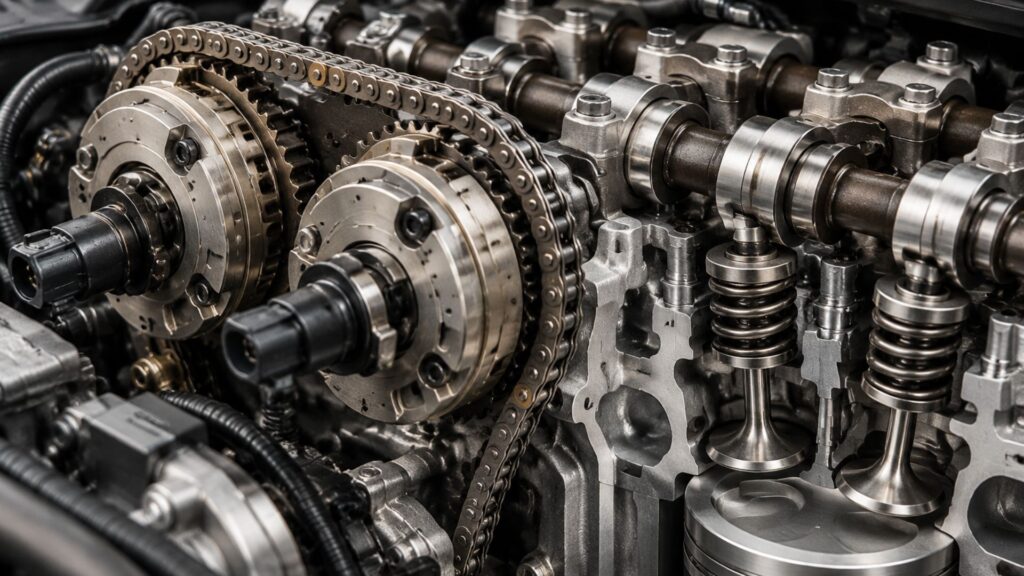
The core of most VVT systems is a component called the camshaft phaser. This is a gear-driven device that sits at the end of the camshaft and can rotate it slightly forward or backward relative to the crankshaft. Even a small shift in camshaft position changes when the valves open and close, which has a measurable effect on engine behavior.
The engine control unit – your car’s main computer – sends signals to solenoids that control oil pressure directed at the phaser. The phaser then adjusts its position based on that oil pressure. This all happens within milliseconds, continuously, while you’re driving.
Some manufacturers use more advanced systems that control valve timing and lift simultaneously, giving even more precise control over how the engine breathes. Honda’s VTEC and BMW’s Valvetronic are well-known examples, though most automakers have developed their own versions under different names.
The Role of Engine Oil in VVT Systems
Here’s something many drivers don’t think about: VVT systems are almost entirely dependent on clean, properly pressurized engine oil to function correctly. The camshaft phasers are actuated by oil pressure, and the solenoids that direct that pressure can clog or malfunction if the oil is dirty or low.
This is one of the most overlooked reasons why regular oil changes matter. Skipping them doesn’t just shorten engine life in a general sense – it can directly compromise your VVT system’s performance and trigger warning lights on your dashboard.
If you’re due for an oil change or haven’t had one in a while, that’s worth addressing sooner rather than later.
How Variable Valve Timing Actually Boosts Power
So how does adjusting valve timing translate into more power? It comes down to something called volumetric efficiency – how effectively the engine fills its cylinders with the air-fuel mixture needed for combustion.
At high RPMs, the engine is cycling through combustion events very quickly. By adjusting intake cam timing, the system can help the valves open at the right moment, allowing more air and fuel to enter the cylinder before the valves close. More fuel and air mean a bigger combustion event, and that means more power.
At lower RPMs, the system can retard the cam timing instead, reducing overlap between the intake and exhaust valves. Less overlap means fewer exhaust gases contaminating the incoming air-fuel charge, which results in smoother, more complete combustion and better fuel efficiency.
This ability to optimize for different driving conditions is the real power behind VVT. It’s not just about peak horsepower – it’s about having the right amount of power at the right time, efficiently.
Torque at Low Speeds, Horsepower at High Speeds
One of the most practical benefits of variable valve timing is that it helps engineers build engines with strong torque at low RPMs and solid horsepower at high RPMs. Before VVT, getting both from the same engine was extremely difficult without turbocharging or adding engine displacement.
This is why a modern four-cylinder engine can keep up with older six-cylinder engines in many real-world driving situations. The engine is constantly optimizing itself based on what you’re asking it to do.
Improved Fuel Economy Without Sacrificing Performance
VVT also plays a direct role in fuel economy, which is why it became standard on so many vehicles starting in the late 1990s and early 2000s. By reducing pumping losses – the energy wasted pushing exhaust gases out and pulling fresh air in – the engine works more efficiently at cruising speeds.
Some systems even allow cylinders to be deactivated during light-load driving by manipulating valve timing. This is how cylinder deactivation technology works in many modern trucks and SUVs.
Common VVT System Components You Should Know
Understanding the parts involved helps you make sense of repair estimates and diagnostic results. The main components include:
- Camshaft phasers – the actuators that physically adjust cam position
- VVT solenoids – also called oil control valves, these direct oil pressure to the phasers
- Timing chain and guides – the mechanical link between the crankshaft and camshaft
- Engine control unit (ECU) – the computer that reads sensor data and commands the solenoids
- Camshaft position sensors – these report actual cam position back to the ECU for feedback control
When any of these components fail or perform poorly, the system can’t adjust timing correctly, and you’ll often feel it in performance, fuel economy, or both.
Signs Your VVT System May Be Having Problems
VVT systems are generally reliable, but they do wear out over time – especially if oil changes have been neglected. Here are some signs that something may be off:
- A rough idle that wasn’t there before
- Noticeable loss of power, especially during acceleration
- Decreased fuel economy without an obvious explanation
- A check engine light with codes related to camshaft timing or VVT solenoids
- A rattling or ticking noise from the engine, particularly when it’s cold
That rattling sound is worth paying special attention to. A stretched timing chain or worn phaser can produce a distinct metallic rattle on startup. If you’re hearing that in New Castle, IN, it’s not something to put off – timing chain issues can lead to significant engine damage if left unaddressed.
What Happens If VVT Problems Are Ignored?
In the early stages, a VVT problem might just mean slightly rougher idling or a marginal drop in fuel economy. But if the underlying cause is oil starvation, a failing solenoid, or a worn phaser, things can escalate.
A timing chain that slips or breaks can cause the valves and pistons to collide, which is the kind of damage that can total an engine. That’s an extreme case, but it’s not unheard of – and it’s entirely preventable with timely diagnosis and repair.
If your check engine light is on and the code is related to camshaft timing, don’t clear it and hope for the best. Get it properly diagnosed by technicians who understand these systems.
How VVT Is Diagnosed and Repaired
Diagnosing VVT problems correctly requires professional scan tools that can read live data from the camshaft position sensors and compare it to what the ECU is commanding. A generic code reader might tell you there’s a cam timing issue, but it won’t tell you whether the problem is a bad solenoid, low oil pressure, a worn phaser, or a software issue.
At Don and Joe’s Auto Service in New Castle, IN, ASE-certified technicians use state-of-the-art computer diagnostic equipment to pinpoint exactly what’s happening with your engine. That means you’re not paying for guesswork – you’re paying for an accurate diagnosis and a repair that addresses the actual cause.
Most VVT solenoid replacements are straightforward jobs. Phaser replacement is more involved and usually requires timing chain service at the same time. Either way, a proper diagnosis first saves you from replacing parts that didn’t need to come out.
Does Every Car Have Variable Valve Timing?
Most vehicles built after 2005 have some form of VVT. It’s now considered a standard feature on gasoline engines because the fuel economy and emissions benefits are significant enough that automakers needed it to meet regulatory standards.
If you’re driving a newer vehicle – truck, SUV, sedan, or crossover – there’s a very good chance your engine has VVT. That’s worth knowing because it means your oil change schedule isn’t just about lubrication in a general sense. It directly affects a precision hydraulic system that’s working constantly while you drive.
VVT in Trucks and SUVs
Trucks and SUVs with VVT sometimes have more complex systems because they’re designed to balance towing capability, highway cruising, and sometimes cylinder deactivation. The added demand these vehicles face makes proper maintenance even more critical.
If you’re running a truck or SUV in New Castle, IN and you’ve been stretching your oil change intervals, it’s worth getting caught up before any VVT-related symptoms appear.
Frequently Asked Questions About Variable Valve Timing
Can a VVT problem cause a car to fail emissions testing?
Yes, it can. If the system isn’t controlling cam timing correctly, it can affect combustion efficiency and increase exhaust emissions. A failed VVT solenoid, for example, can cause incomplete combustion and elevated hydrocarbons in the exhaust.
How long do VVT components typically last?
With regular oil changes using the correct oil specification, the major VVT components – phasers and solenoids – can last well over 100,000 miles. Neglected oil maintenance is the most common reason they fail prematurely.
Is it safe to drive with a VVT code?
In most cases, you can drive short distances, but you shouldn’t ignore it. Depending on the code and the underlying cause, continued driving can worsen the problem. Get it checked as soon as reasonably possible.
What oil type does a VVT system require?
Always use the viscosity and specification listed in your owner’s manual. Many VVT-equipped engines require 0W-20 or 5W-30 full synthetic oil. Using the wrong viscosity can affect how quickly the phasers respond and how well the system performs overall.
How much does VVT repair typically cost?
It varies quite a bit depending on the vehicle and which component needs attention. A solenoid replacement is generally less expensive than phaser or timing chain work. The best way to get an accurate number is through a proper diagnosis first, which Don and Joe’s provides with free estimates when performing the work.
How Proper VVT Maintenance Protects Power and Efficiency
Variable valve timing is one of the most useful technologies in modern engines, delivering real-world benefits in power, efficiency, and emissions. But like any precision system, it depends on proper maintenance – especially clean, correct engine oil – to keep working as intended.
If you’re noticing rough idling, reduced power, or a check engine light related to cam timing, don’t wait for the problem to grow. Schedule an engine diagnostic with the team at Don and Joe’s Auto Service at 765-529-3555 and get a straight answer from technicians who know these systems inside and out.