
That Engine Knocking Sound Means Rod Bearings Are Dying
You hear it the moment you start your car. A deep, rhythmic knocking noise coming from somewhere inside the engine. It gets louder when you accelerate. Your gut tells you something is seriously wrong, and your gut is right.
That sound is not something you can ignore or hope goes away. In most cases, what you are hearing is the early warning that your rod bearings are failing, and if you keep driving, you are risking catastrophic engine damage.
What Is That Knocking Sound, Exactly?
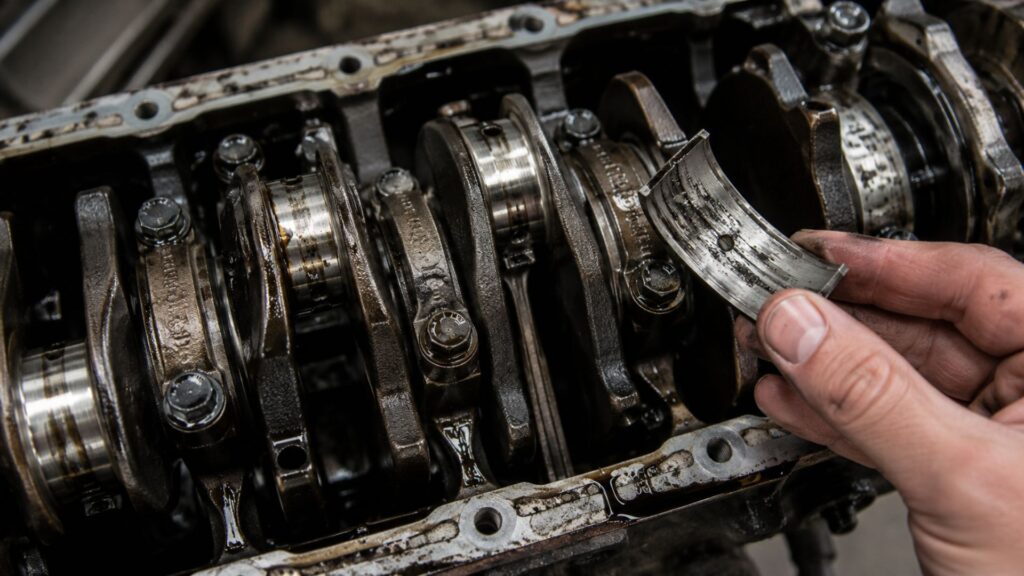
Inside every internal combustion engine, pistons move up and down inside cylinders to compress the air-fuel mixture and create combustion. Each piston connects to the crankshaft through a connecting rod. Where that rod meets the crankshaft, there are small components called rod bearings.
Rod bearings are designed to keep the connecting rod and crankshaft moving smoothly together. They rely on a thin film of oil to prevent metal-to-metal contact. When that oil film breaks down or the bearing wears out, the connecting rod starts to knock against the crankshaft journal with every rotation of the engine.
That knock you hear? That is metal slamming against metal thousands of times per minute.
Why Do Rod Bearings Fail?
Rod bearing failure does not usually happen overnight. It builds up over time, and there are a handful of reasons it develops.
- Low oil pressure or dirty oil is the most common cause. Engine oil is what keeps rod bearings lubricated. When oil levels drop, oil becomes thick with soot and carbon buildup, or the oil pump loses pressure, the bearings start running dry. Skipping oil changes or ignoring the oil pressure warning light speeds this process up dramatically.
- Worn bearings from high mileage are another cause. Bearings do not last forever. As a vehicle ages, the bearing surfaces wear thin, and clearances grow beyond what the oil film can bridge.
- Fuel dilution can also destroy bearings faster than expected. When gasoline gets into the oil – often from a faulty fuel injector or repeated short trips where the engine never fully warms up – it thins out the oil and reduces its ability to protect bearing surfaces.
- Incorrect octane rating in your gasoline matters too. Running fuel with a lower octane rating than your engine requires causes engine knock from pre-ignition, which puts extra stress on pistons, connecting rods, and the bearings that support them.
- Ignition timing problems are a related culprit. If your ignition timing is off, combustion happens at the wrong moment in the cylinder cycle. This creates abnormal pressure spikes that hammer the rod bearings over time.
How to Tell If It Is Definitely Rod Bearing Knock
Not every engine knocking sound is a rod bearing. There are other causes of knock worth knowing about.
A spark plug that is loose or misfiring can create a light ticking or knocking sound, but it tends to be higher-pitched and less rhythmic. A timing belt problem can produce irregular noises that change with engine speed. Detonation knock – caused by poor air-fuel ratio or low-octane gasoline – often sounds like a rapid metallic rattling when you accelerate.
Rod bearing knock, by contrast, has a few distinct characteristics. It is a deep, hollow knocking sound. It is rhythmic and corresponds directly to engine RPM. It gets louder under load, such as when accelerating or going uphill. It is often loudest during a cold start and may quiet down slightly once the engine warms up and oil pressure builds, but it does not disappear.
If you are hearing that kind of knock, this is not something to second-guess; you need to get the vehicle looked at immediately.
What Happens If You Keep Driving?
Here is where people make a costly mistake. They hear the knock, they hope it will hold, and they keep driving.
When a rod bearing fails completely, the connecting rod can break free entirely. In the worst cases, the rod punches through the engine block itself. At that point, you are not looking at a bearing replacement. You are looking at a full engine replacement or a vehicle that is no longer worth repairing.
The difference between catching this early and catching it late can be the difference between a repair in the hundreds of dollars and a repair in the thousands.
What Rod Bearing Repair Involves
Replacing rod bearings is not a simple job. A technician needs to drop the oil pan, access the crankshaft, remove each connecting rod cap, inspect the crankshaft journals for scoring or damage, and install new bearings with the correct clearances.
If the crankshaft journals are worn or scored, they may need to be machined or the crankshaft replaced entirely. The oil passages need to be cleaned out. The cause of the failure – whether it was an oil maintenance issue, a fuel pump problem, or something else – has to be identified and corrected so the new bearings do not fail just as fast.
This is precision work. It is the kind of repair where experience and accuracy matter more than speed.
Maintenance Habits That Protect Your Rod Bearings
The best way to avoid rod bearing failure is consistent, attentive maintenance.
Change your oil on schedule using the correct viscosity for your engine. Check your oil level regularly between changes, especially on older vehicles. Pay attention to your oil pressure gauge. If the light comes on, stop driving and call for help. Use gasoline with the recommended octane rating for your vehicle. Address any fuel system issues, including a failing fuel pump or injector problems, before they escalate. And if you ever hear a new noise from your engine, do not wait.
Whether you drive a Ford F-Series, a daily commuter, or anything in between, the engine knock warning is never one to dismiss.
Don’t Ignore Rod Bearing Knock
Rod bearing knock is one of the most serious sounds a vehicle can make, and waiting is never the right call. The experienced ASE-certified technicians at Don and Joe’s Auto Service in New Castle, IN have been diagnosing and repairing engine problems since 1977. They have the knowledge and tools to assess what is happening inside your engine and give you an honest answer.
If your engine is knocking, call Don and Joe’s at 765-529-3555 today and get it checked before a manageable repair becomes a full engine replacement.