
Transfer Case vs Differential: Two Jobs, One Drivetrain
If you’ve ever heard a mechanic mention your transfer case or differential and felt completely lost, you’re not alone. These are two of the most misunderstood components in your vehicle’s drivetrain, and they often get confused with each other. They’re related, yes, but they do very different jobs.
Understanding what each one does – and what happens when one fails – can save you from a costly surprise down the road. Let’s break it down in plain English.
What Is a Drivetrain, Anyway?
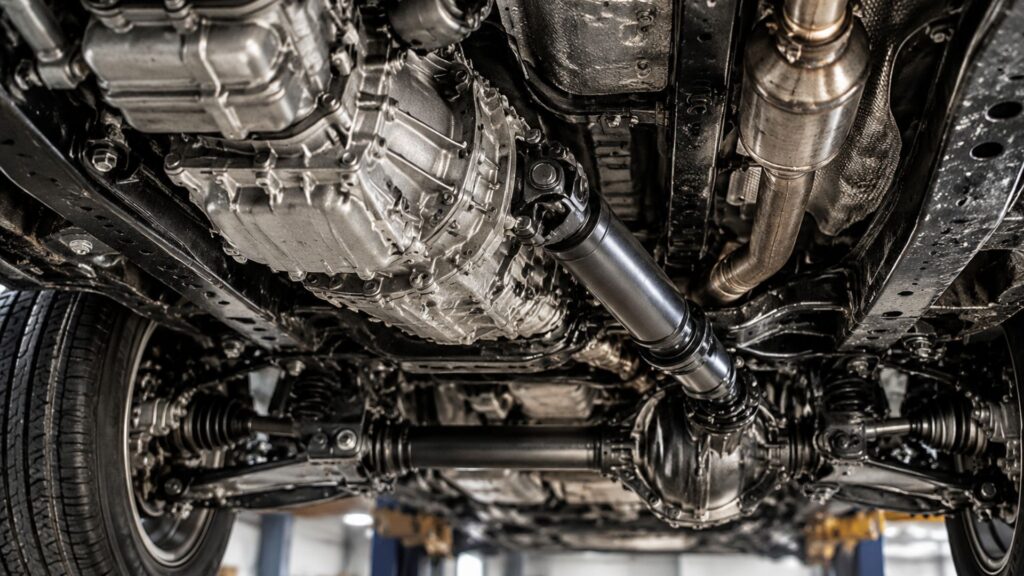
Before we get into the individual parts, it helps to understand what the drivetrain actually is. In simple terms, the drivetrain is everything that moves power from your engine to your wheels. That includes the transmission, driveshaft, axles, and yes – the transfer case and differentials.
Think of it as a chain of components, each one passing power along to the next. If any link in that chain breaks down, your vehicle isn’t going anywhere.
What Does a Transfer Case Do?
The transfer case is a component found only in four-wheel drive (4WD) and all-wheel drive (AWD) vehicles. Its job is to split engine power between the front and rear axles so all four wheels can be driven simultaneously.
On a typical 4WD truck or SUV, the transfer case is what engages when you switch into 4-High or 4-Low. It takes power coming from the transmission and distributes it to both the front driveshaft and the rear driveshaft at the same time.
Part-Time vs Full-Time Transfer Cases
Not all transfer cases work the same way. Here’s how the two main types differ:
- Part-time transfer cases are found in traditional 4WD vehicles. They let you switch between 2WD and 4WD depending on driving conditions. These are common on pickup trucks and older SUVs.
- Full-time transfer cases are found in AWD systems. They continuously send power to all four wheels without any driver input. Many crossovers and modern SUVs use this setup.
The key point is that the transfer case manages power distribution between axles, meaning front versus rear. It doesn’t handle what happens at each individual wheel – that’s where the differential comes in.
What Does a Differential Do?
The differential is a gear assembly located at each axle, and its job is to allow wheels on the same axle to rotate at different speeds. This matters more than most drivers realize.
When you make a turn, your outer wheels need to travel a longer distance than your inner wheels. If both wheels on the same axle were locked to spin at the exact same speed, turning would cause serious tire scrubbing, binding, and premature wear. The differential solves this problem by letting each wheel spin independently based on the resistance it encounters.
Types of Differentials
Most vehicles have more than one differential, depending on their drivetrain layout.
- Rear differential – found on rear-wheel drive (RWD) vehicles and most 4WD trucks
- Front differential – found on front-wheel drive (FWD) vehicles and 4WD/AWD vehicles
- Center differential – found on some AWD systems to manage power between the front and rear axles (similar in function to a transfer case)
There are also limited-slip differentials (LSDs) and locking differentials, which are performance or off-road upgrades that control how much wheel spin is allowed between the two sides of an axle.
Transfer Case vs Differential: The Core Difference
Here’s the simplest way to remember it: the transfer case splits power between the front and rear axles, while differentials split power between the left and right wheels on a single axle.
They work together as part of the same drivetrain system, but they operate at different points in the power delivery chain. A 4WD vehicle typically has one transfer case and two or more differentials all working at the same time.
If you’re driving a rear-wheel drive car, you have no transfer case at all – just a rear differential. If you’re in a 4WD pickup, you likely have a transfer case, a front differential, and a rear differential all doing their jobs simultaneously.
Signs Your Transfer Case Might Be Failing
Transfer case problems tend to announce themselves in pretty noticeable ways. Here are some symptoms worth paying attention to:
- Difficulty shifting into or out of 4WD
- Grinding or clunking noises when engaging four-wheel drive
- Fluid leaking from under the center of the vehicle
- The vehicle unexpectedly popping out of 4WD while driving
- Unusual vibrations at highway speeds
Transfer case fluid, like transmission fluid, breaks down over time. Neglecting it can lead to serious internal damage. If you’re noticing any of these symptoms, it’s worth having the system inspected before the problem gets worse.
Signs Your Differential Might Be Failing
Differential problems often start subtly and get worse over time. Watch for these warning signs:
- A whining or howling noise coming from under the vehicle, especially during turns
- A clunking sound when accelerating from a stop
- Vibration that seems to come from the rear or front axle area
- Tire wear that seems uneven or premature without an obvious alignment cause
- Difficulty making sharp turns, especially at low speeds
Differential fluid is another commonly overlooked service item. It gets dirty and breaks down just like engine oil, and skipping the fluid change can lead to worn gears and costly repairs.
How Often Should These Components Be Serviced?
Most manufacturers recommend inspecting and servicing transfer case and differential fluids every 30,000 to 60,000 miles, though this varies by vehicle. If you do a lot of towing, off-roading, or driving in extreme conditions, you may need more frequent service.
The honest truth is that most drivers never think about these components until something goes wrong. Routine drivetrain maintenance – including fluid checks on the transfer case and differentials – is a simple way to avoid expensive repairs later.
What Happens If You Ignore a Problem?
Letting a transfer case or differential issue go unaddressed rarely ends well. What starts as a minor leak or a fluid service overdue by a few thousand miles can turn into a complete gear failure. Replacing a differential or transfer case outright is significantly more expensive than a fluid change or early repair.
Beyond the cost, a failing transfer case or differential can affect your vehicle’s handling and safety. In a 4WD vehicle, a bad transfer case can leave you without 4WD when you actually need it – like during a winter storm or in slippery conditions.
Driveline Repair at Don and Joe’s Auto Service
At Don and Joe’s Auto Service in New Castle, IN, the team has been diagnosing and repairing drivetrain issues since 1977. Whether it’s a transfer case that won’t engage, a differential making noise, or a fluid service that’s been overdue for too long, the ASE-certified technicians here know how to handle it.
They use state-of-the-art diagnostic equipment to accurately assess what’s happening before any work begins. And because most parts and labor come with a 1-year warranty, you can drive away with real confidence in the repair.
Don and Joe’s offers free estimates before performing the work, so there are no surprises when it comes to the cost. If you’re hearing strange noises from under your vehicle or have questions about your drivetrain, they’re ready to help.
Frequently Asked Questions
Do all vehicles have a transfer case?
No. Only 4WD and AWD vehicles have a transfer case. If you drive a two-wheel drive car or truck, you have differentials but no transfer case.
Can I drive with a bad transfer case?
It depends on the severity of the issue, but in most cases, you shouldn’t. A failing transfer case can affect how power reaches your wheels and may create a safety hazard. It’s best to have it inspected right away.
Is the transfer case the same as the transmission?
No, they are separate components. The transmission manages gear changes and engine power output. The transfer case receives that power from the transmission and distributes it to multiple axles.
How do I know if I need differential fluid or transfer case fluid?
Both fluids should be checked during routine service. A mechanic can inspect fluid condition and levels as part of a standard drivetrain inspection. If either fluid looks dark, contaminated, or is low, it should be replaced.
Are limited-slip differentials worth it?
For everyday driving, a standard open differential works fine. But if you tow, drive off-road, or live somewhere with rough winter conditions, a limited-slip differential can provide better traction and control.
Keep Your Transfer Case and Differentials Working Properly
The transfer case and differential both play critical roles in getting power to your wheels, but they operate at different points in the drivetrain and solve different problems. Keeping both properly maintained protects your vehicle and your wallet. If you’re due for a drivetrain inspection or you’re hearing something that doesn’t sound right, reach out to the team at Don and Joe’s through their driveline repair service page or call 765-529-3555 to schedule an appointment.