

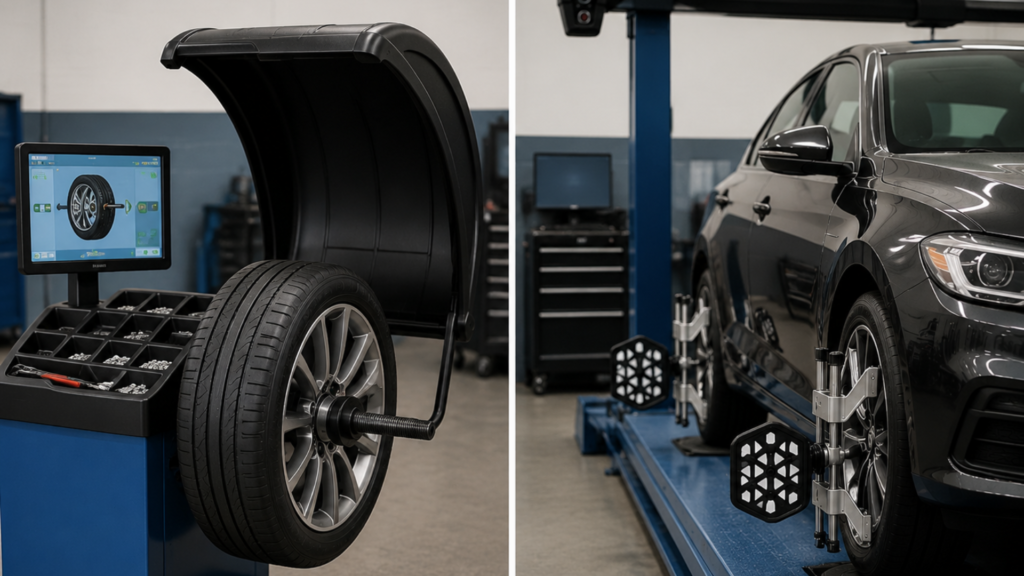
Tire Balancing Vs Alignment: Which One Does Your Car Really Need?
Your steering wheel is shaking. Your tires are wearing unevenly. Something feels off, but you are not sure what. Sound familiar?
Most drivers assume they need one or the other – tire balancing or wheel alignment – but the truth is, these are two completely different services that solve two completely different problems.
Mixing them up is easy, but getting the wrong service means wasting money and leaving the real issue unresolved.
Here is a clear, honest breakdown of what each service actually does and how to tell which one your car is asking for.
What Is Tire Balancing?
Tire balancing is exactly what it sounds like. It corrects uneven weight distribution around a tire and wheel assembly. When a tire is mounted on a wheel, tiny imperfections in both the tire and the rim can cause one side to be slightly heavier than the other.
That imbalance might seem small, but at highway speeds, it causes a noticeable vibration – usually felt in the steering wheel, the seat, or the floorboard. A technician uses a balancing machine to spin the wheel and detect where the weight is off, then attaches small counterweights to bring everything into balance.
Common Signs You Need Tire Balancing
- Vibration in the steering wheel or vehicle cabin, especially at speeds above 50 mph
- Uneven or scalloped tire wear patterns
- Poor fuel efficiency that has no other explanation
- The car feels rougher than usual on smooth roads
Tire balance issues are often caused by normal wear and tear over time, hitting a pothole, or simply driving thousands of miles. Most manufacturers recommend having your tire balance checked every 5,000 to 6,000 miles or whenever you notice vibration.
What Is Wheel Alignment?
Wheel alignment is about angles, not weight. It refers to adjusting the direction and angle of your tires so they are perfectly parallel to each other and perpendicular to the road – essentially making sure every wheel is pointing in the right line.
A car’s suspension connects the wheels to the vehicle frame, and over time, that suspension can shift. Hitting a curb, driving on rough roads, or general wear and tear can all knock your alignment out of spec. Even a minor misalignment changes how your tires make contact with the road.
Common Signs You Need a Wheel Alignment
- Your car pulls to the left or right even when you are driving straight
- The steering wheel is off-center when the car is going straight
- Uneven tire wear – one edge wearing faster than the other
- The car feels loose or drifts without input from the steering wheel
Alignment is measured in three angles: camber, toe, and caster. You do not need to memorize those terms, but a technician will check all three to make sure your tires are sitting and rolling exactly as the manufacturer intended.
Tire Balancing Vs Alignment: The Key Differences
It helps to see these two services side by side.
Tire Balancing | Wheel Alignment
| |
|---|---|---|
What it fixes | Uneven weight distribution | Incorrect tire angles |
Main symptom | Vibration | Pulling or drifting |
What wears out | Tires unevenly | Tires on one edge |
Involves | Counterweights on the wheel | Adjusting suspension angles |
How often | Every 5,000-6,000 miles | Every 1-2 years or after an impact |
Both services protect your tires from premature wear, improve fuel economy, and keep your car handling the way it should. But they are not interchangeable.
Do You Need Both at the Same Time?
Absolutely. In fact, it is common. If you have been driving on misaligned tires for a while, the uneven contact with the road can also throw off your tire balance. Many shops – including the team at Don and Joe’s Auto Service in New Castle, IN – recommend addressing both during the same visit to save time and catch everything at once.
Cold inflation pressure also plays a role here. Tires that are consistently under- or over-inflated will wear unevenly regardless of how well they are balanced or aligned. Always check your vehicle care regularly.
How a Technician Figures Out Which You Need
A good technician does not guess. They start with a visual inspection of the tires, looking at wear patterns. From there, they may use a sensor-equipped balancing machine or a computerized alignment rack to get precise readings.
Wear on the center of the tread often points to inflation issues. Wear on both outer edges suggests the tires have been under-inflated. Wear on one edge almost always points to an alignment problem. Cupping or scalloping across the tread is a classic sign of a tire balance issue.
Which Service Does Your Car Need?
If your car is vibrating, you likely need a tire balance. If it is pulling or your tires are wearing on one edge, a wheel alignment is probably the answer. When in doubt, let a professional take a look before the problem gets worse.
The team at Don and Joe’s Auto Service has been diagnosing and fixing exactly these kinds of issues for drivers in New Castle, IN, since 1977. Schedule your suspension and brakes service or call us at 765-529-3555.