

Bad Ball Joint Symptoms That Precede Total Failure
That strange noise coming from your front end is not something to brush off. A clunk, squeak, or pull in your steering wheel could be your car’s way of warning you that a ball joint is on its way out. And when a ball joint fails completely, the results can be dangerous.
What Is a Ball Joint and Why Does It Matter?
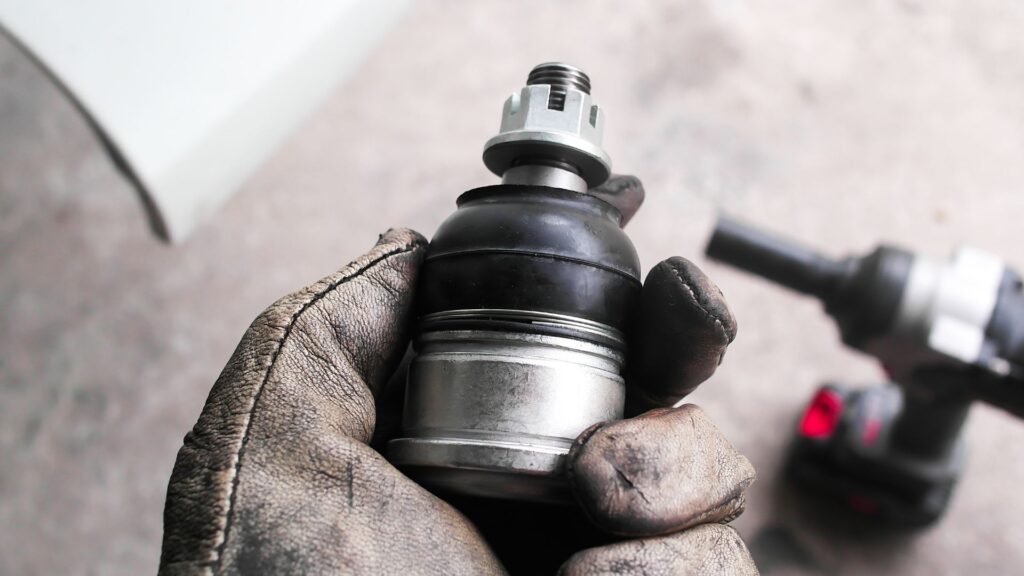
A ball joint is essentially a ball-and-socket joint that connects your control arm to your steering knuckle. It allows your wheel to move up and down while also pivoting for steering. Think of it as the pivot point between your car’s suspension and its steering system.
Without a functioning joint, your tire loses its proper contact with the road. That affects suspension and braking – all at once.
What Causes Ball Joints to Wear Out
Ball joints do not fail overnight. They wear down gradually from a mix of age, mileage, and driving conditions.
- Normal wear and tear. Every ball joint has a lifespan, and most start showing wear between 70,000 and 100,000 miles depending on the vehicle and how it is driven.
- Torn or damaged boots. A rubber boot seals grease inside the joint. Once that boot cracks or tears, dirt and moisture get in, and lubrication gets out. From there, wear speeds up fast.
- Potholes and rough roads. Hard impacts put sudden stress on the joint and can loosen it well before its expected mileage.
- Rust and corrosion. Road salt and moisture, especially through Indiana winters, can corrode the joint and its housing over time.
- Skipped maintenance. Non-sealed ball joints need periodic greasing. Missing that step lets the joint dry out and wear faster than it should.
Knowing the cause helps explain why two cars with similar mileage can have very different ball joint conditions.
Bad Ball Joint Symptoms You Should Not Ignore
That Clunking Noise Is the First Red Flag
The most common early sign is a clunking or knocking noise, especially when hitting bumps or turning. This noise comes from the worn ball-and-socket joint moving loosely inside its housing. ChrisFix and other automotive sources consistently list this as symptom number one.
Uneven Tire Wear
When a ball joint wears down, the wheel angle shifts. That misalignment causes your tire to wear unevenly across its surface. If you notice cupping or feathering on one tire but not the other, the bearing and joint assembly deserve a closer look.
Drifting or Pulling While Steering
A bad joint can cause your vehicle to drift or pull to one side even on a straight road. Your steering wheel may also feel loose or vibrate at highway speeds. These signs and symptoms point to a suspension problem that is getting worse, not better.
Visible Play in the Wheel
A jack test can reveal excessive play in the wheel when lifted off the ground. A technician can spot movement in the joint and arm assembly that confirms wear beyond acceptable limits.
The Risk of Waiting Too Long
Complete ball joint failure can cause a wheel to separate from the vehicle entirely. At that point, you lose all steering control. The risk is not just vehicle damage – it is a serious safety hazard for you and everyone on the road around you.
How Much Does Ball Joint Replacement Cost?
Ball joint replacement cost depends on your vehicle, whether one side or both need work, and whether the joint is a standalone part or built into the control arm.
- Parts and labor typically range from $150 to $450 per joint, though some vehicles with integrated control arm assemblies can run higher.
- Front lower ball joints wear out most often and are usually the most affordable to replace.
- An alignment is usually needed afterward to make sure your wheels are set correctly once the new joint is in.
- Catching it early keeps the cost down. Waiting until a joint fails completely can damage the control arm, wheel hub, or tires, which turns a single-part repair into a bigger bill.
For an exact number, a technician needs to see the vehicle and confirm which joints are affected. Schedule an inspection, and we will give you a straight answer before any work begins.
Frequently Asked Questions
How long can you drive with a bad ball joint?
It depends on how worn the joint is, but driving on a failing ball joint is never safe for long. Once you notice clunking, drifting, or play in the wheel, treat it as urgent and get it inspected right away.
Can a bad ball joint cause a wheel to fall off?
Yes. In a worst-case scenario, a completely failed ball joint can let the wheel separate from the vehicle, which means a total loss of steering control.
Is a clunking noise always a ball joint problem?
Not always. Worn sway bar links, tie rods, or struts can cause similar noises. That is why a hands-on inspection matters more than guessing from the sound alone.
Do both ball joints need to be replaced at the same time?
Not necessarily, but many shops recommend replacing them in pairs if both are near the same mileage, since one is likely to fail soon after the other.
When Bad Ball Joint Symptoms Mean It’s Time for an Inspection
Bad ball joint symptoms start small but escalate fast. Clunking, uneven tire wear, and a drifting steering wheel are your vehicle’s early warnings. The team at Don and Joe’s Auto Service in New Castle, IN has been diagnosing suspension and brake issues since 1977. If something feels off in your front end, do not guess – get it checked.
Schedule a suspension inspection with our trusted technicians by calling 765-529-3555 before a worn joint becomes a roadside emergency.