

Why Your Brake Pedal Travels To Floor And What To Do Next
There are few things more unsettling than pressing the brake pedal and feeling it sink toward the floor. It’s the kind of moment that makes your heart race, especially when you’re moving at speed on the road. If this has happened to you, you’re not alone – and more importantly, it’s a problem you should never ignore.
Understanding why your brake pedal goes to the floor is the first step toward fixing it safely.
How Brakes Work In The First Place
Before diving into what goes wrong, it helps to know how brakes work under normal conditions.
When you step on the brake pedal, your foot force is multiplied through a hydraulic system.
Brake fluid moves through brake lines, applying pressure to calipers or wheel cylinders, which then squeeze against the rotor or drum to slow the vehicle.
Power brakes also rely on a brake booster – typically powered by engine vacuum – to give you power assist, so pressing the pedal doesn’t require excessive effort. When any part of this chain breaks down, pedal travel increases and stopping power drops.
Common Causes Of A Brake Pedal That Goes To The Floor
There isn’t just one reason a brake pedal sinks to the floor. Several distinct problems can cause this, and each one requires a different fix.
A Failing Master Cylinder
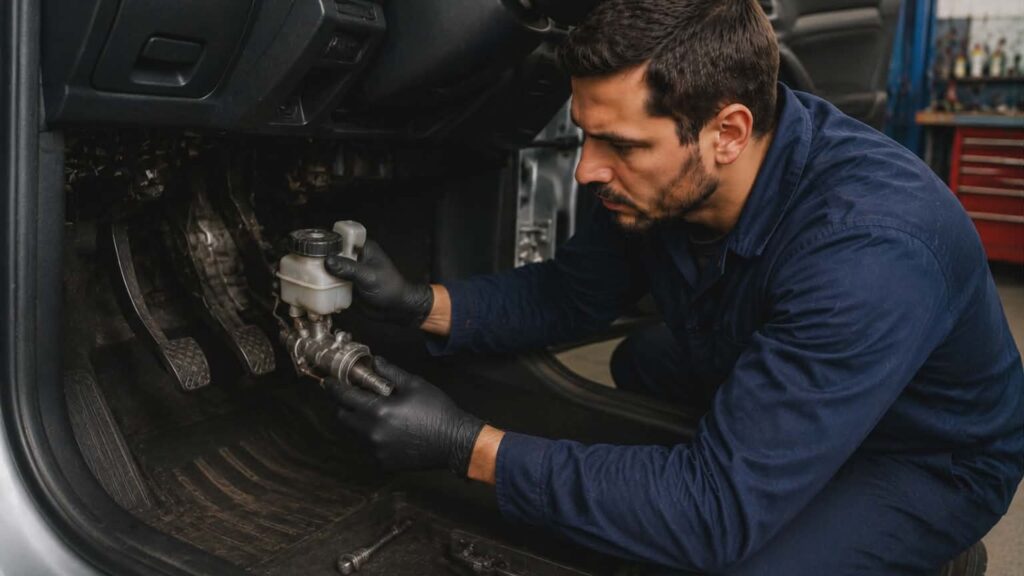
The master cylinder is the heart of your car’s hydraulic brake system. It converts the pressure from your foot into hydraulic pressure that activates the brakes at each wheel. When the master cylinder starts to fail – often because of a worn internal piston or seal – brake fluid can bypass internally without doing any work.
The result is a low brake pedal that sinks when you press the pedal, even though there’s no visible fluid leak outside the system. Installing a new master cylinder is often the fix for this specific issue.
Air In The Brake Lines
Brake fluid is incompressible, which is exactly what makes hydraulic brakes effective. But air compresses easily, and when air enters the brake lines, the pedal feels spongy or squishy instead of firm. You might notice the pedal sometimes goes further than usual, or that pedal feels soft every time you hit the brakes.
Bleeding the brakes – a process where a mechanic forces fluid through the system to get the air out – typically resolves this. If the air keeps coming back, there’s likely a fluid leak somewhere letting air in.
A Brake Fluid Leak
A leak is one of the most common causes of brake pedal problems. Brake fluid can escape from several points: a damaged brake line, a defective caliper, worn wheel cylinders, or a cracked brake fluid reservoir. When fluid escapes the system, hydraulic pressure drops, and the pedal doesn’t feel right.
You may notice a puddle of fluid under your vehicle, or your brake fluid reservoir may be running low. Either way, there’s a leak that needs to be located and repaired before it gets worse.
A Faulty Brake Booster
The brake booster uses engine vacuum to provide power assist, so the pedal requires less foot effort. When the booster fails, you lose that power assist, and the pedal doesn’t feel normal – it may feel hard to push or oddly soft depending on how the failure occurs.
A defective vacuum servo won’t always cause the brake pedal to go all the way to the floor, but it can contribute to a low brake pedal and reduced braking performance. A technician can diagnose booster problems by checking vacuum pressure and testing pedal behavior with the engine off versus running.
What To Do If Your Brake Pedal Sinks While Driving
If your brake pedal goes to the floor while you’re driving, stay calm and take these steps:
- Try pumping the brake pedal a few times quickly to build hydraulic pressure. This can temporarily restore some braking force.
- Use the parking brake carefully to help slow the vehicle if the service brakes aren’t working.
- Downshift if you’re driving a manual transmission to use engine braking.
- Move to the side of the road as safely as possible and turn on your hazard lights.
- Do not attempt to drive the vehicle further. Call for help.
A brake pedal that goes to the floor is an emergency. Treating it as anything less risks a serious accident.
Why You Shouldn’t Wait for Brake Inspections
Brake problems rarely fix themselves, and they almost always get worse with time. If your pedal always feels a little low, or the pedal doesn’t feel right but you’re managing, that’s not a reason to wait. That’s a warning.
At Don and Joe’s Auto Service in Henry County, IN, the team provides thorough brake inspections as part of their suspension and brake repair services. We can diagnose everything from a worn brake pad to a failing master cylinder using advanced computer diagnostics for vehicles, ensuring nothing gets missed.
Our routine preventative maintenance services also include fluid checks that catch a low brake fluid level before it becomes a road emergency. And if a bigger repair is needed, our comprehensive auto repair services cover everything from a new brake line to a complete brake system overhaul.
Conclusion
A brake pedal that travels to the floor is never something to shrug off. Whether the cause is a worn master cylinder, air in the lines, a fluid leak, or a failing booster, the fix starts with a proper diagnosis from someone who knows the automotive industry inside and out. Don and Joe’s Auto Service has been keeping drivers in Henry County, IN, safe since 1977. Call us at 765-529-3555 or to schedule an inspection before a small brake problem becomes a dangerous one.